creative ramblings & reverie

Tuesday, December 27, 2022

Writing Spaces


Writing from my heart, today, to fill the space of gray, the in-between spaces, the spaces that words can't quite light.  Some images that warm me, in this year-end time, the not-quite-threshold time, the waiting, waning time not yet ready to wax.


images:  Jean Misceslas Peské, Femme à l'ouvrage; Medieval roof angels, 15th c, St Agnes, Cawston, Norfolk; Francis Killan, Bird Woman; Maurice Marinot, Intérieur; Odilon Redon, Fleurs


Wednesday, December 21, 2022

Winter Solstice


On this shortest day, this day to reflect and stay still, to revel in silence, I've turned again to my account of one of the perfect silent retreats that restored me in years past.  (And this year, sadly, the leader of those retreats has passed too.)

___


Back from a day’s silent retreat at the Green Gulch Zen temple and farm, I’m full of quiet wisdom.  I’ve come back not with the silence itself, which is hard come-by in our obstreperous world, but the capacity for silence (as my father wrote about never losing the capacity for happiness, however unhappy we might be).  This is the richer gift, I see.  The key to that place inside myself I can return to, over and over, at need; where I can hear birdsong, or twigs falling onto the canvas of the yurt, where I can hear my heart expressing gratitude over a simple handful of October flowers, the hard wood (Eucalyptus) and the soft wood (pine) ready for our first-morning fire should we need one, the taste of peppermint tea made with two teabags.  


The capacity for brilliant yellow, too—the walls of the old wooden laundry room, open at both ends.  Inside humming with clean clothes tumbling in a row of dryers, outside colored the most intense and radiant yellow, from (I’m guessing) lichens or pollens collecting on the wood over the years.  Accumulating yellow:  a good way to live.  (And like my favorite painter, Pierre Bonnard, who used to go back and add yellow to his finished paintings, sometimes years later.)


In the silence I learned I need to listen to my heart, foremost.  I walked out to the ocean with the others, because my bad knee didn’t let me walk that far the last time I was there, so my mind told me I needed to make up for that.  It told me I like the walk, and the ocean.  All of that true, but what I really wanted, above all, was to sit the whole while in the garden, which I don’t just like, but love.  The beach was terribly crowded, with people happily engaged in their noisy business, and though that taught me an important lesson once before—that I don’t need to be a part of that, that I can maintain my silence and just observe (something I do naturally anyway)—it wasn’t what my heart needed.  Not then.  So I walked quickly back to the garden, and spent a precious ten minutes just being there, with end-of-summer roses, lichen-ey old wooden trellises, my favorite apple tree in all the world, a couple and dog on the grass, the play of sunlight and late-afternoon early-October shadow just perfect by then, the silence absolute—except for my heart’s exclaiming its utter delight.


Another of the members of our group had said at introduction time that he had recently decided to quit work, to work on opening his heart.  Meaning that going on working was led by mind, and trying something else important for heart.  I know I need to do that too—live that yellow!—and maybe some day soon will find the courage to do so.  To know that following my heart is the right thing to do.  Not willful or unwise (as I’ve been gravely taught over the years), but essential.  The wise course born of silence.


(October 2014)


image:  Pierre Bonnard, Bouquet de mimosas

Saturday, December 17, 2022

Kachinas: A Christmas Story


I'm pleased that my short story "Kachinas" has been published in the December issue of Grande Dame Literary Journal—an appropriately seasonal tale, making me terribly nostalgic for New Mexico and its incomparable way of being.


 "Lil didn't know the meaning of the intricate rhythms and steps, since no outsiders were allowed to know, but she felt it somewhere deep within, encouraged by the drums. The story being told and prayer offered. The waiting clouds they danced into being, and quickened into hope. Nimbus, nimbostratus, the fertile, undulating clouds Xavier painted with abandon, with enormous swooping strokes of not just fingers, wrist, but his whole body—in a way becoming cloud himself, just as the dancers in their masks became the spirit-beings they embodied. Kachinas." 


This story is part of a thread also including "The Persian Warrior," "Day of the Dead," and "L'inconnue de la Seine."


And I, henceforth, would love the honorific "Grand Dame."


image:  Kachinas, photographer unknown

Monday, November 28, 2022

Writing Spaces


"The Moving Finger writes; 

and, having writ, Moves on . . . "

(Omar Khayyám)


image:  photographer unknown

Sunday, November 6, 2022

Ghost Light


"a kind of glow—humanity, noblesse, beatitude—lingered in the great spaces that like Space itself held stars already dead but luminous, inherently present, the residue of suns long since burned out.  Ghost light, Aash thought of it."


Just published in Livina Press Literary Magazine, Issue 2, Fall 2022 (print only)—my short story "Ghost Light," set in the ruins of the Ashmolean Museum in Oxford, a museum which was originally a collaboration between the places and peoples of its collections and between the collections and the viewers who engaged with them.  And then between me, the author, who's collected them again, and the characters I have sent into the ruins to collect what they can of what's left after the world's culture has been destroyed and most animals and plant-life gone extinct.


This work is a collaboration too with the author of a book one of the characters once read—Russell Hoban, who offered his amazing The Lion of Boaz-Jachin and Jachin-Boaz to the world.  The book is integral to my main character's identity, and has remained for many years in my own consciousness, now informing my writing.  In it are extinct lions, which are regenerated in the haunted spaces of the museum, later joined by other extinct animals gathered between the covers of a salvaged bestiary.


And finally, or really first, the work is a collaboration between me and a writer friend's grandson, Westley, who offered us the first line as a gift.


At its heart this story is about the essential shared responsibility of carrying the memories of things past, things gone, as we all do—together saving what we can in these destructive times.  It no longer takes a village.  It takes a world.  A museum, with all its salvaged, plundered ghosts.


image:  photographer unknown

The Queens Gambit [sic]


I've had a quirky short story published in Flights (just print, so far, but online someday, it's suggested)—"The Queens Gambit."  Not a typo; indeed there's no apostrophe, because the story's set in Queens, NY, and involves chess somewhat peripherally.  A gambit is the core of it, "a device, action, or opening remark, typically one entailing a degree of risk, that is calculated to gain an advantage," and specifically, as in chess, "an opening in which a player makes a sacrifice, typically of a pawn, for the sake of some compensating advantage."


A subconscious long-ago inspiration was apparently Guy de Maupassant's "The Necklace," which I hadn't remembered, and I much more consciously had in mind the twist in O. Henry's "The Gift of the Magi."


It's a playful tale at heart, and was great fun to write.  Fun to remember some of the chess moves and concepts from the also long-ago days when I played often and voraciously.


One of the main characters is Tante Cristelle, moved from Guadeloupe to Paris for art school to Far Rockaway, Queens—

"In recent days he'd seen his landlady becoming a ghost-in-training.  Gliding around the house both day and night, moving chess pieces stealthily in games they'd left out to finish (always to good effect), cunningly challenging the stairs as if they were an ascent of Kilimanjaro.  She went unseeing and all but unseen, shuffling along the upstairs corridor in a bathrobe the color of oatmeal but set off by her many-colored carnival headdresses, meant to hide her nearly hairless head, with her wheeled walker—a skeletal companion who Gino had seen her do something like salsa with, Haitian kompa he thought she'd said.  The last of her dance partners in this world, likely.  And on her ancient phonograph at odd hours she set playing Maurice Ravel's "Five O'Clock Foxtrot," a favorite of her Paris beau ("prince of the sturgeon eggs," she'd called him).  Ravel had been in Paris when she got there, Cristelle had once reminisced, her proud head cocked sideways, seeing it all, her young-again profile splendid."


image:  Chess Game, artist unknown

Monday, July 25, 2022

Sacred Space: or, Sitting a Spell


This meditative essay has been published in MockingOwl Roost (Volume 2, Issue 3:  Introspection), and is surely nothing if not introspective.  I felt extremely lucky to have found the space inside this discombobulated year to dwell from time to time in a lovely cerebral realm, lofty and light and well above the fog-line, and was happy to be shaping a gauzy blue and silver tissue of ideas in defiance of my off-and-on-again dull fuzzy-headedness.  The finished piece feels almost like things I wrote in graduate school, when I was fully in my element.


At some point while sitting a spell, I came across this poem about quiet power that seemed to beautifully sum up the power I was summoning (or hoping to) in my meditations.


The Quiet Power

I walked backwards, against time

and that’s where I caught the moon,

singing at me.

I steeped downwards, into my seat

and that’s where I caught freedom,

waiting for me, like a lilac.

I ended thought, and I ended story.

I stopped designing, and arguing, and

sculpting a happy life.

I didn’t die. I didn’t turn to dust.

Instead I chopped vegetables,

and made a calm lake in me

where the water was clear and sourced and still.

And when the ones I loved came to it,

I had something to give them, and

it offered them a soft road out of pain.

I became beloved.

And I came to know that this was it.

The quiet power.

I could give something mighty, lasting,

that stopped the wheel of chaos,

by tending to the river inside,

keeping the water rich and deep,

keeping a bench for you to visit.

– Tara Mohr


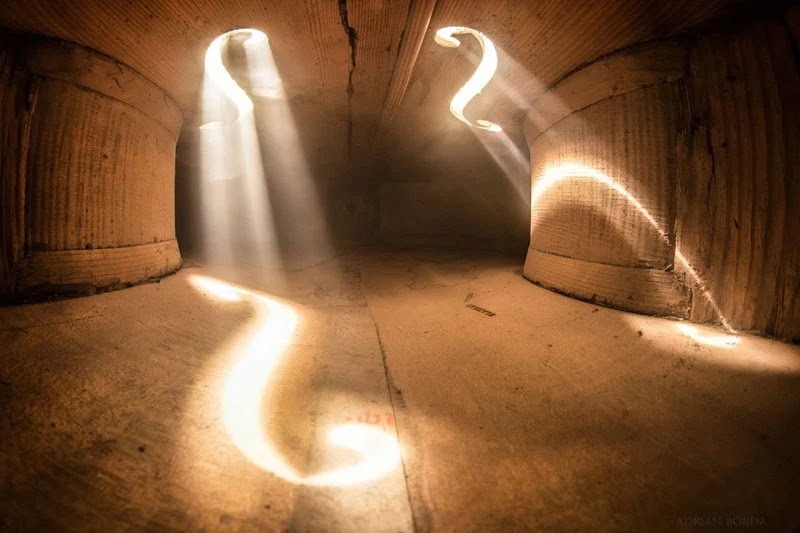
image:  Antelope Canyon, Arizona (reminding me as well of the quiet and sacred space—humming with possibility—that has been photographed by Adrian Borda inside cellos)